
The game in detail: Packet Dominance rules and mechanics
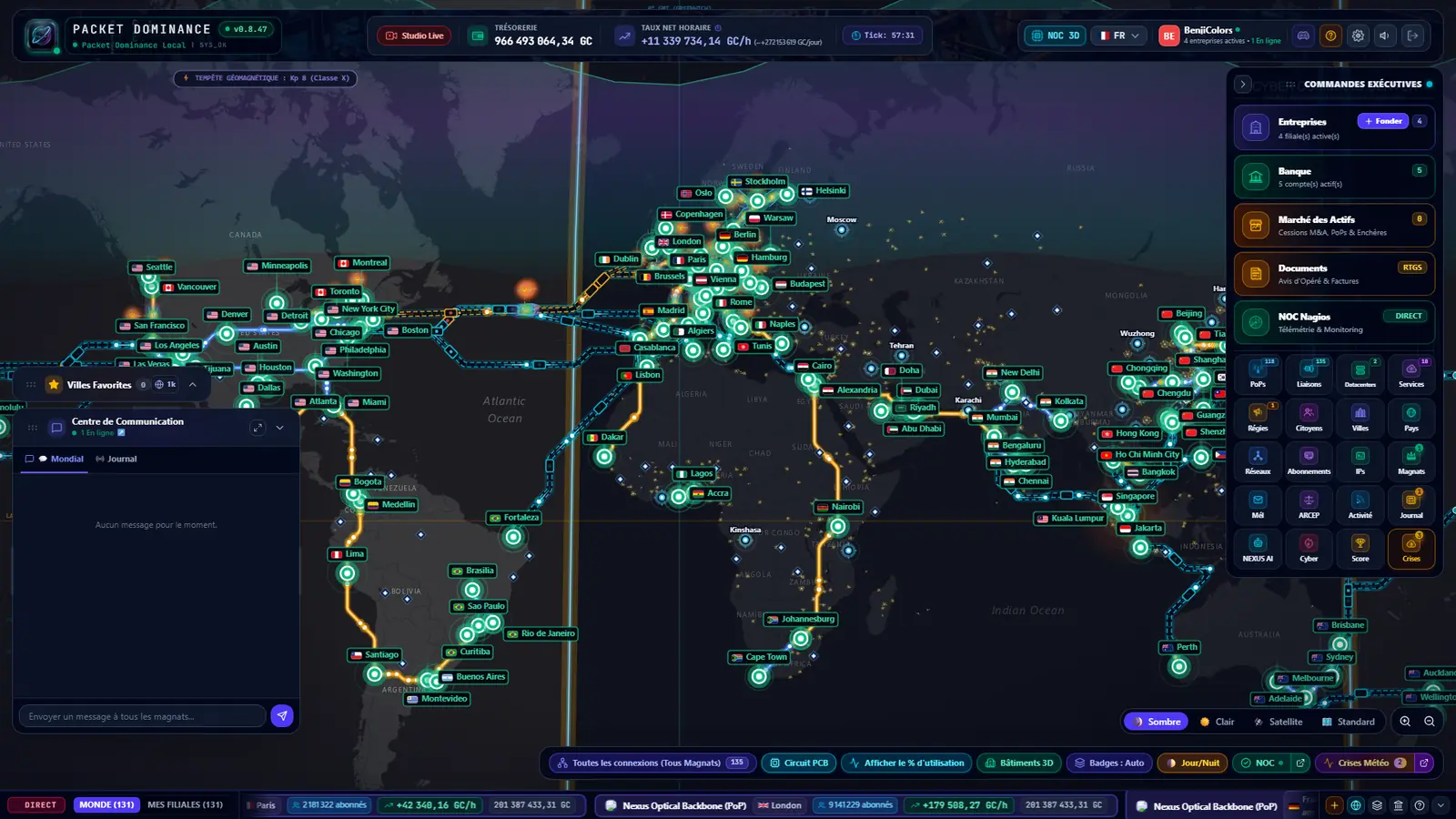
Packet Dominance is a free multiplayer economic strategy game, played in the browser. Each player builds a group of companies that owns a share of the Internet's infrastructure: points of presence and fiber cables, datacenters, digital services and ad networks.
The game is played on a map of 1,000 real cities spread across 242 countries, each with its own tax system. Time is real: one hour of play lasts one hour, and every hour the server computes a tick that collects revenue, pays costs and levies taxes for every company, whether its owner is logged in or not. Every new player starts with 20,000 GC, the game's currency, and nothing else.
The game rests on four lines of business that depend on one another. The Internet service provider (ISP) connects residents and links cities; its plans only bring in money if at least one service is reachable on its network, as detailed in network, fiber and BGP. The hosting provider builds datacenters, from Tier 1 to Tier 20, and rents out their compute units; see datacenters. The service publisher runs applications drawn from a catalog of 100 services and competes for subscribers; the ad network brings it more, as the services and subscribers page explains.
Around these businesses, the economy is accounted for to the cent: accounts per company, a Central Bank that lends nothing, no dividends, an Exchange where only whole subsidiaries are sold, and seizure after 240 consecutive hours of deficit (economy and banking). The world is not stable: heatwaves, solar storms, cable cuts and attacks between players, arbitrated by a regulatory authority (crises and cyberwarfare). Finally, a player can hand their account over to an AI assistant through the MCP protocol (AI agents and MCP).
The pages below detail each system. The figures quoted are those of the game engine, checked against its code.