
Crises and cyberwarfare in Packet Dominance: heatwaves and DDoS
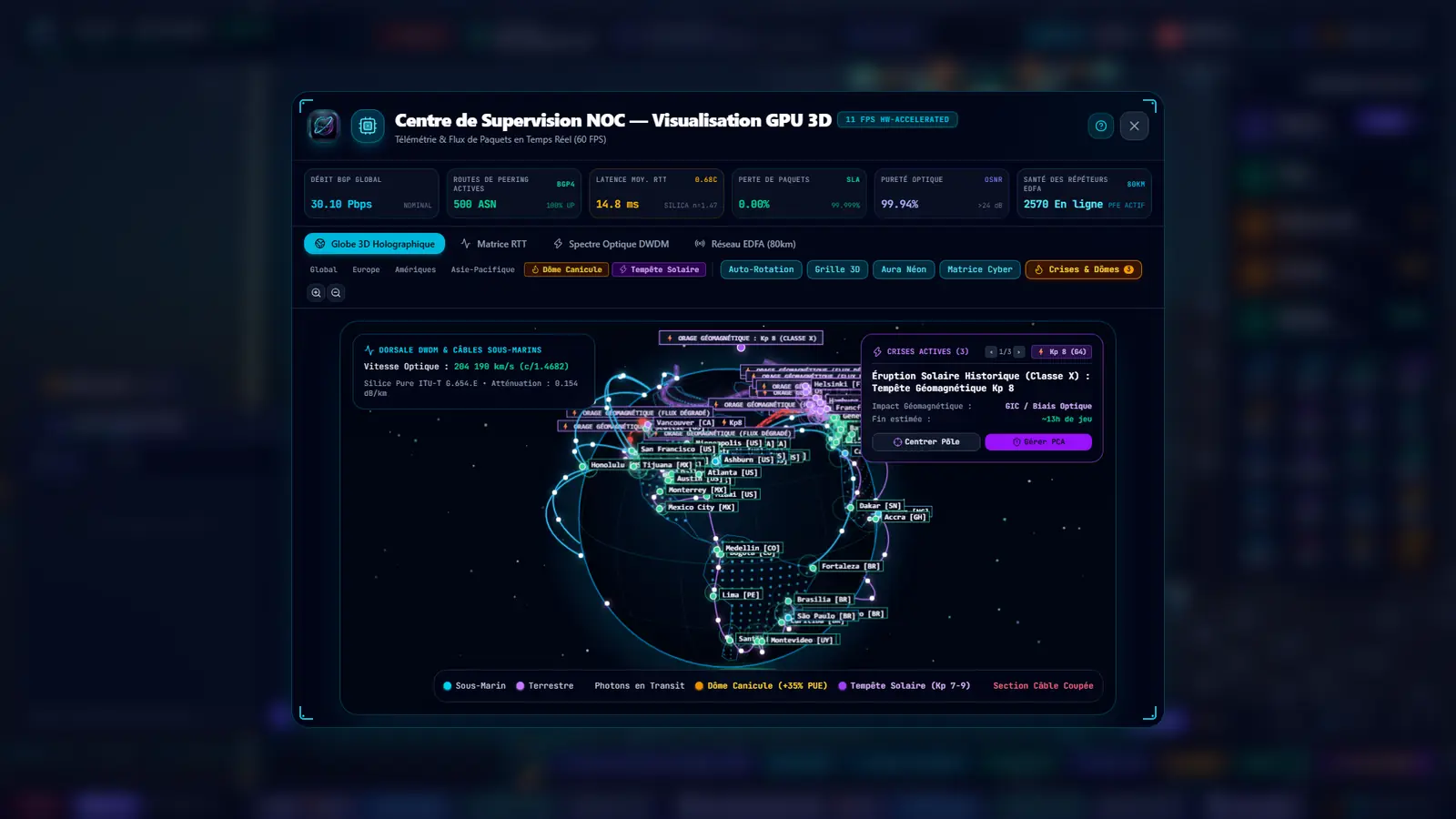
The world of Packet Dominance is never calm. Automatic global crises strike the datacenters and cables of every player, and players can attack one another with simulated DDoS attacks. All of this remains a game mechanic, with no real traffic at all: simulated compute units (CU), subscribers and amounts in GC.
Three global crises
In a new world, the first heatwave arrives 24 hours after opening, the first cable cut between 48 and 72 hours, and the first solar storm between 96 and 144 hours.
Heatwaves
A heatwave is triggered every 24 hours and lasts from 10 to 22 hours. It strikes one of five epicenters: the Western Mediterranean (1,400 km radius), the Middle East and Gulf (1,600 km), the Southern United States (1,500 km), Southeast Asia (1,300 km) or the Indian subcontinent (1,600 km). Each datacenter in the zone pays, every hour, a surcharge of racks × 12 GC × rate, from 35% at the epicenter to 7% at the edge. A Tier 4 (10 racks) at the epicenter thus pays 42 GC/h before tax.
Solar storms
After 96 hours of calm, a storm has a 5% chance of being triggered at each tick; it arrives no later than 144 hours after the previous one. It lasts from 12 to 18 hours, with a Kp index of 7, 8 or 9, and hits every city located at 45° latitude or higher, north or south: Paris, London and Berlin included. Each cable with one end in the zone drops to 25% of its capacity, and each datacenter pays a surcharge of 17% to 114% of racks × 12 GC.
Cable cuts
Only one cut at a time: after 48 hours of calm, a 5% chance per tick, no later than 72 hours after the previous one. Half the time it is a subsea cable, repaired in 8 hours by a cable ship; otherwise a terrestrial cable, repaired in 6 hours. During the repair, which is automatic and free, the cable keeps only 25% of its capacity. If all of a city's cables are saturated, the city is frozen: no more new subscribers, but none lost.
BCP, Beginner Shield and surcharges
The Business Continuity Plan (BCP) costs 2,500 GC, deducted from your personal account. It reduces the surcharge of a heatwave or a solar storm by 60%, starting from the next tick. A contract covers a single crisis. It is only sold if it has an effect: never for a cable cut, nor under the Beginner Shield. At the epicenter of a heatwave, it saves 2.52 GC per rack per hour: it only pays off beyond about 992 rack-hours.
The Beginner Shield exempts from any heatwave and storm surcharge a player who registered less than 72 hours ago, or whose personal account holds less than 50,000 GC. It does not protect their cables from storms; a cut spares, when it can, a beginner's only cable.
Cyberwarfare: DDoS attacks between players
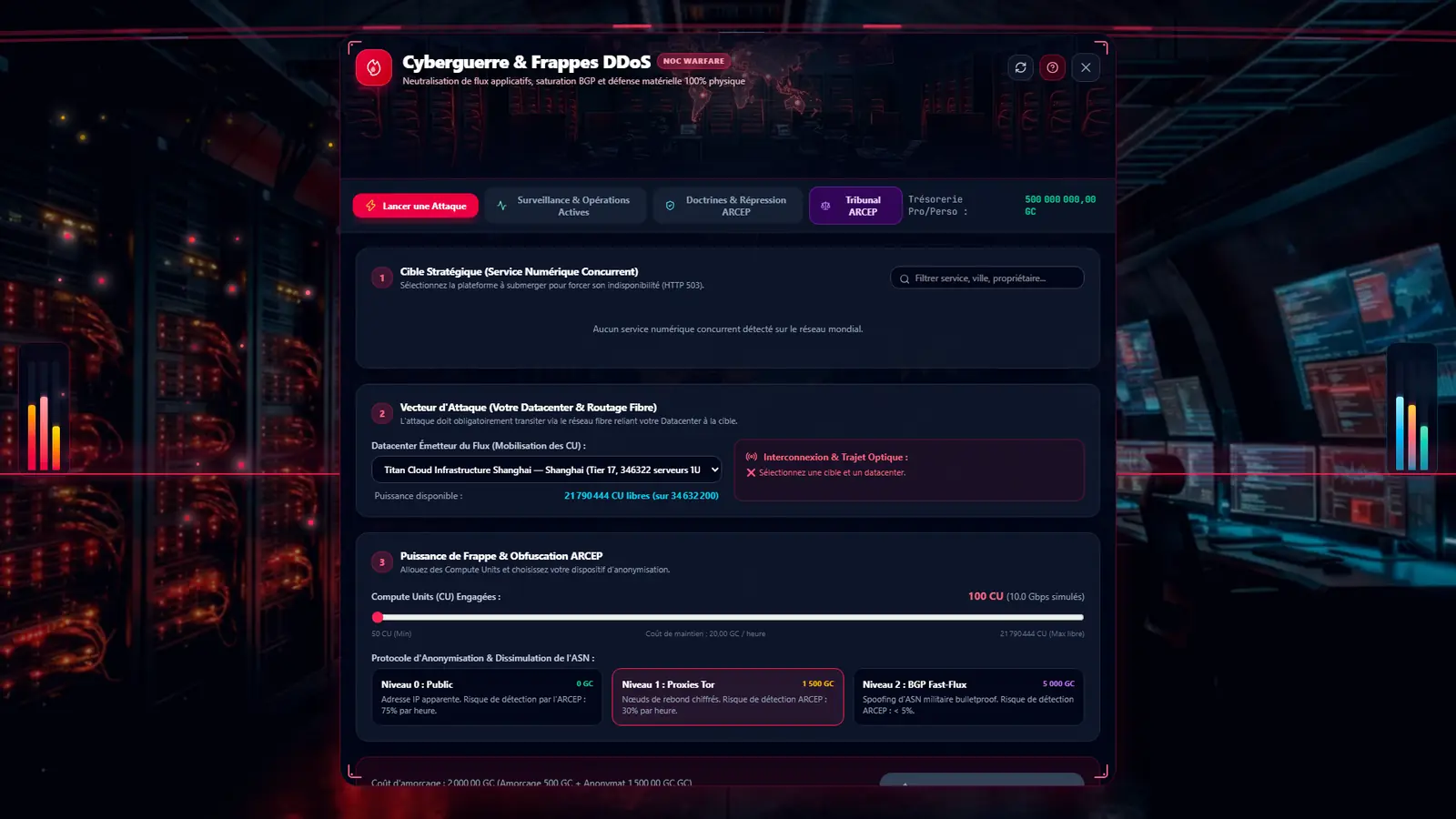
An attack mobilizes the free CU of one of your datacenters against another player's service, in the same city or the same cable network. It takes at least 50 CU. The cost: 500 GC to launch plus the price of anonymity, then 0.20 GC per CU per hour. There are three anonymity levels: none (free), Tor network (1,500 GC) and Fast-Flux (5,000 GC).
The game adds up the CU of all attacks against a campus and compares them with its defense. If they are equal or lower, the attack is absorbed. Above that, the targeted services go down: no revenue, and 20% of their subscribers lost at each tick (at least 10).
Defense and scrubbing
Defense is installed in the racks of the targeted campus, in place of servers:
- 1U firewall: 3,500 GC, 15 GC/h maintenance, 100 CU of defense.
- 2U filtering (scrubbing) appliance: 14,000 GC, 50 GC/h, 500 CU.
- 4U chassis: 40,000 GC, 140 GC/h, 2,000 CU.
Each chassis also adds 40% to the attacker's risk of detection, up to +60%. Without a chassis in the targeted campus, an anonymized attacker is never unmasked.
Regulator and tribunal: the victim is the service owner
At each tick, the ARCEP regulator tries to unmask each attack: 75%, 30% or 5% risk depending on anonymity, plus the chassis bonus, capped at 95%. Once unmasked, the attack stops. The fine is 2,500 GC if no subscriber was lost, otherwise 5,000 GC plus 15 GC per lost subscriber. On top of that comes compensation of three months of subscription per lost subscriber, paid to the company that owns the targeted service.
Only that owner can investigate and file a complaint with the ARCEP Tribunal, even if their service is hosted by another player. The forensic analysis identifies the attacker with a 10% to 98% chance depending on its anonymity and the campus's chassis, in a single roll; without a chassis, an anonymized attacker remains untraceable. The complaint is free, limited to one per attack, and judgment is immediate. The penalty is deducted from the attacker, even if overdrawn.
Preparing your empire
Double the cables of your key cities, keep enough to pay for a BCP when a crisis drags on and equip the campuses that host your most profitable services. Choose a world to begin, and reread the rules of the economy and banking before your first attack. Also join the Packet Dominance Discord.