
Digital services and ISP subscribers in Packet Dominance
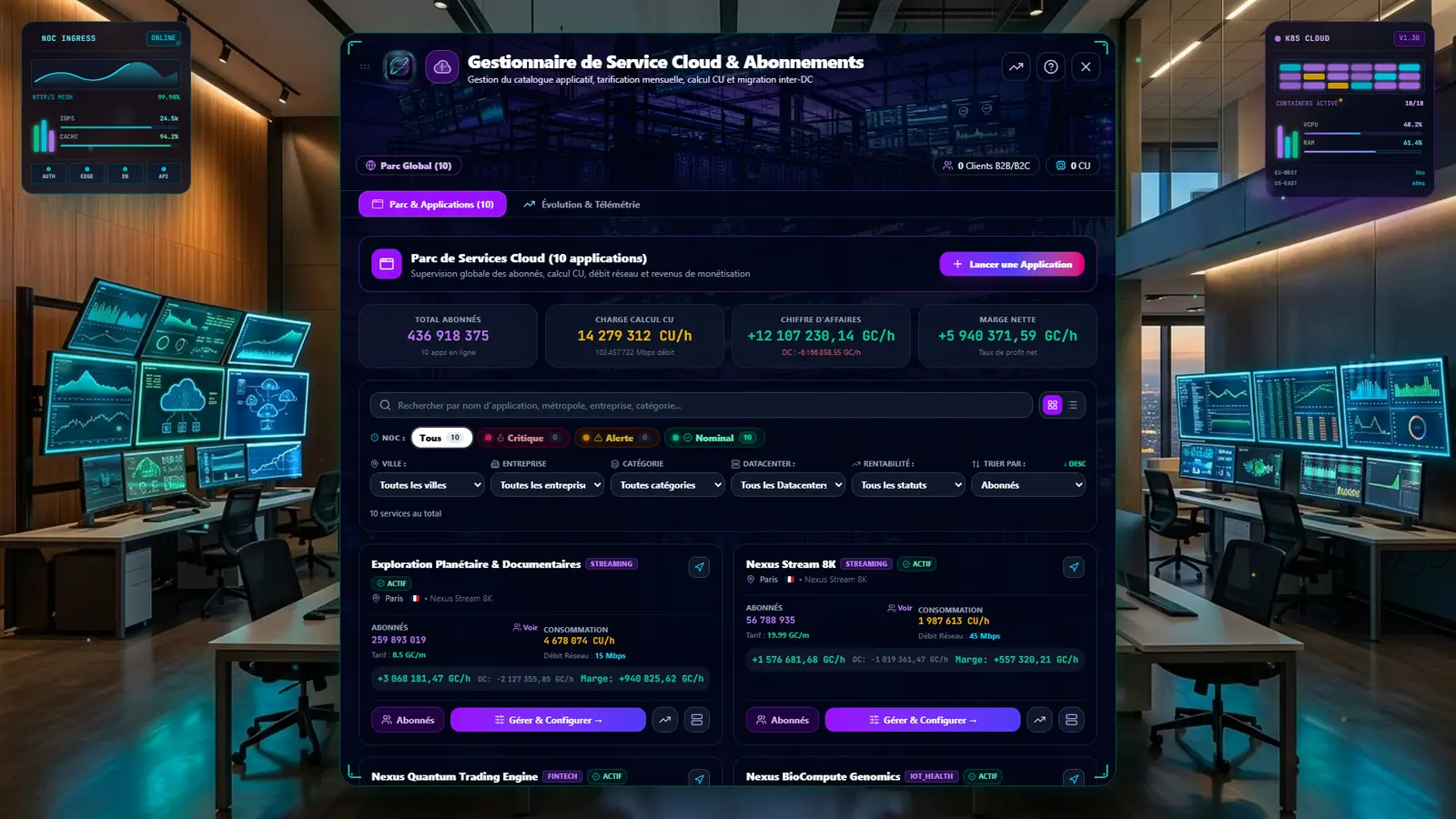
In Packet Dominance, money comes from the residents of the game's 1,000 cities. They pay an Internet plan to their Internet service provider (ISP) and subscriptions to the digital services hosted in datacenters, which ad networks help grow. Here are the engine's rules, applied at each tick (one real hour).
ISP subscribers: one shared market per city
The ISPs of a city share a single market, tier by tier: 10 Mbps, 100 Mbps, 1 Gbps and 10 Gbps.
- Demand: for each ISP, population × its coverage × its price attractiveness. A city's total never exceeds its population.
- Attractiveness: the average over the 4 tiers, with 1.2 where the ISP is the cheapest in the city, otherwise the best price divided by its own.
- New subscribers: 25% at 10 Mbps, 45% at 100 Mbps, 25% at 1 Gbps and 5% at 10 Gbps, assigned to the cheapest ISP in each tier.
- Migration: at each tick, 10% of a tier's subscribers, at each more expensive ISP, move to the cheapest one, within the limit of its capacity. At equal prices, they are shared equally.
- Physical cap: 500 subscribers per Gbps of chassis, that is 50,000 for a 100 Gbps PoP (see the fiber network).
An ISP's plans and costs
By default, a subscriber pays per hour 0.021 GC at 10 Mbps (about 15 GC per month), 0.040 GC at 100 Mbps, 0.068 GC at 1 Gbps and 0.167 GC at 10 Gbps (about 120 GC per month). Each company sets its own prices, from 0.001 GC up to 10, 20, 50 or 100 GC depending on the tier.
Watch out: the city fund only pays for plans if a digital service, belonging to any player, is hosted on the PoP's network. The local loop, on the other hand, costs 0.020 GC per subscriber per hour from the very first tick. On top of that come the chassis maintenance and one technician per block of 2,500 subscribers.
The services catalog
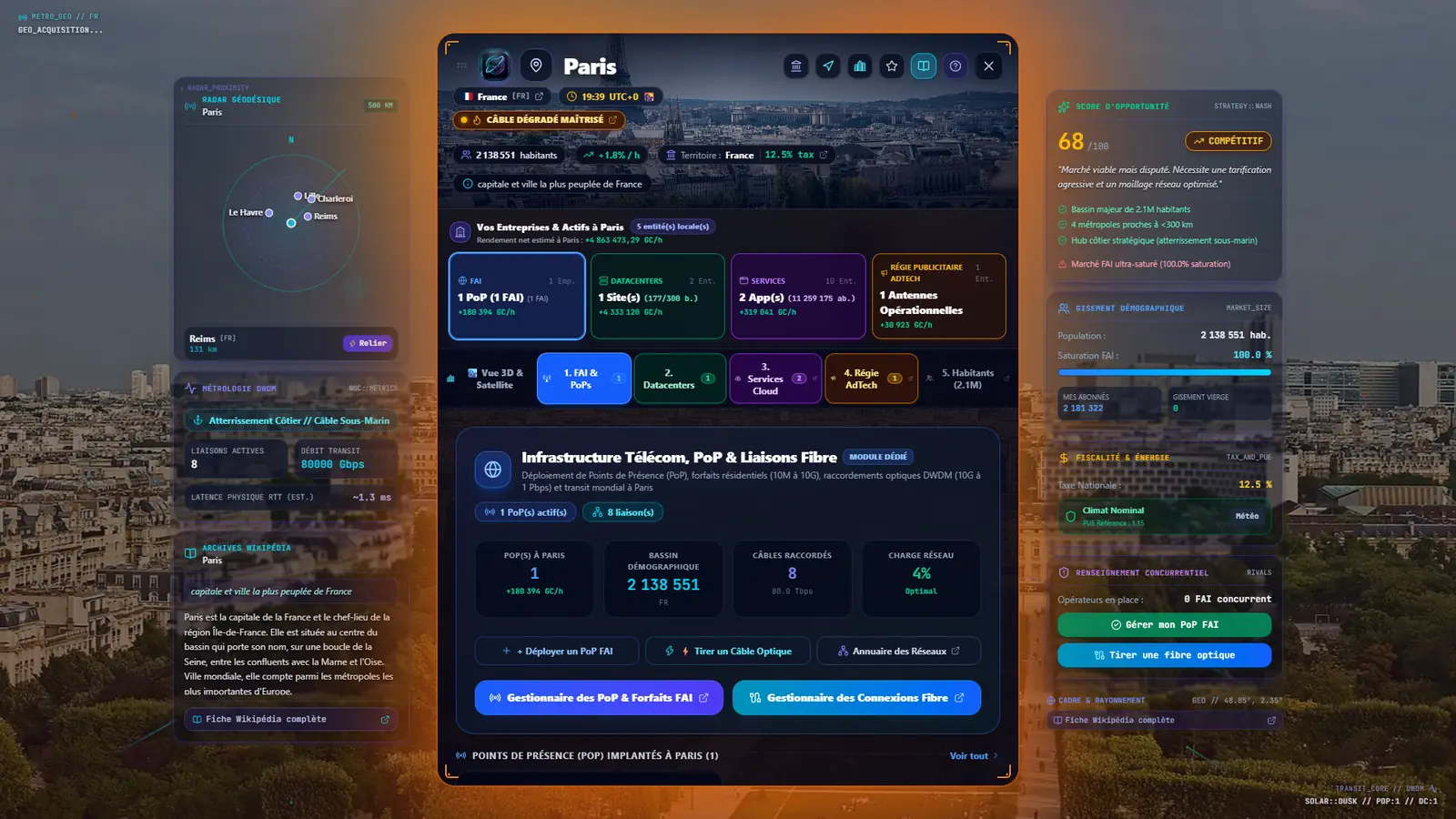
The catalog has 100 services in 10 categories, each appealing to a fixed share of the population: video streaming 38%, social networks 35%, online gaming 32%, storage and e-commerce 30%, artificial intelligence 28%, business software 26%, banking and finance 25%, cybersecurity 24%, health and connected devices 22%.
Launching a service costs 2,500 GC before tax, in a datacenter in the city that has at least one server and enough free CU for 100 subscribers. The service starts with 100 subscribers; its monthly price is free to set (0.99 GC minimum) and can then be adjusted between 0.99 and 299.99 GC.
At each tick, the game calculates a target:
target = reachable population × interest share × 12% × bandwidth factor × network bonus × price ratio
- Reachable population: residents connected to an ISP in the cities of the network, excluding frozen cities.
- Bandwidth factor: 0.6 for the 13 services using more than 30 Mbps per subscriber, otherwise 1.2.
- Network bonus: +15% per city beyond the first, up to ×3.5 from 18 cities.
- Price ratio: 1 for the cheapest in the world on that service, otherwise the best price divided by yours.
Below its target, a service gains 8% of the gap per tick (at least 5 subscribers). It loses subscribers with an overloaded datacenter, a successful DDoS attack (20% per tick) or the price audit: every 5 ticks, a service with more than 50 subscribers that is not the cheapest in the world loses 10% of its subscribers.
A service's revenue and costs
Revenue equals subscribers × monthly price ÷ 720 (hours per month), paid by the fund of the datacenter's city. The service pays for compute (subscribers × CU per subscriber × CU price), network transit (subscribers × Mbps ÷ 1,000 × 0.15 GC) and at least 3 employees.
Example: the "8K Ultra-HD Cinema Hub" at 19.99 GC per month brings in 27.76 GC per hour with 1,000 subscribers. It pays 5.60 GC for compute, 6.75 GC for transit and 15.15 GC in salaries in France: 0.26 GC remains before taxes.
Ad networks and billing
An ad network costs 3,500 GC before tax. It is set up in a datacenter that has at least one server and 20 free CU, and advertises one of your services, in the same city or on the same network, with a reach of 5% to 100%.
- Audience: (reachable population × interest share − the service's subscribers) × reach. Several ad networks on the same service share its non-subscribers.
- Conversion: the service gains 3% of the previous tick's audience, 10 subscribers minimum.
- Campaign: the service pays the ad network 0.002 GC per person of audience per hour, even without conversion; only a complete freeze of its network cancels the bill.
- Compute: the ad network rents 1 CU per 500 people of audience, 10 minimum.
With an audience of 50,000 people, the campaign costs 100 GC per hour, the ad network rents 100 CU (16 GC per hour) and the service gains 1,500 subscribers. Since the campaign money circulates between your own companies, the real gain is the subscribers.
Getting started
- Choose a world from the home page: you start with 20,000 GC.
- Create an ISP, a datacenter and a service in the same city within the same hour: plans are paid from the very first tick.
- Fund your companies' accounts, which open at 0 GC (economy and banking).
- Keep an eye on your prices: the cheapest take the subscribers.