
Fiber network, PoPs, latency and BGP: the Packet Dominance guide
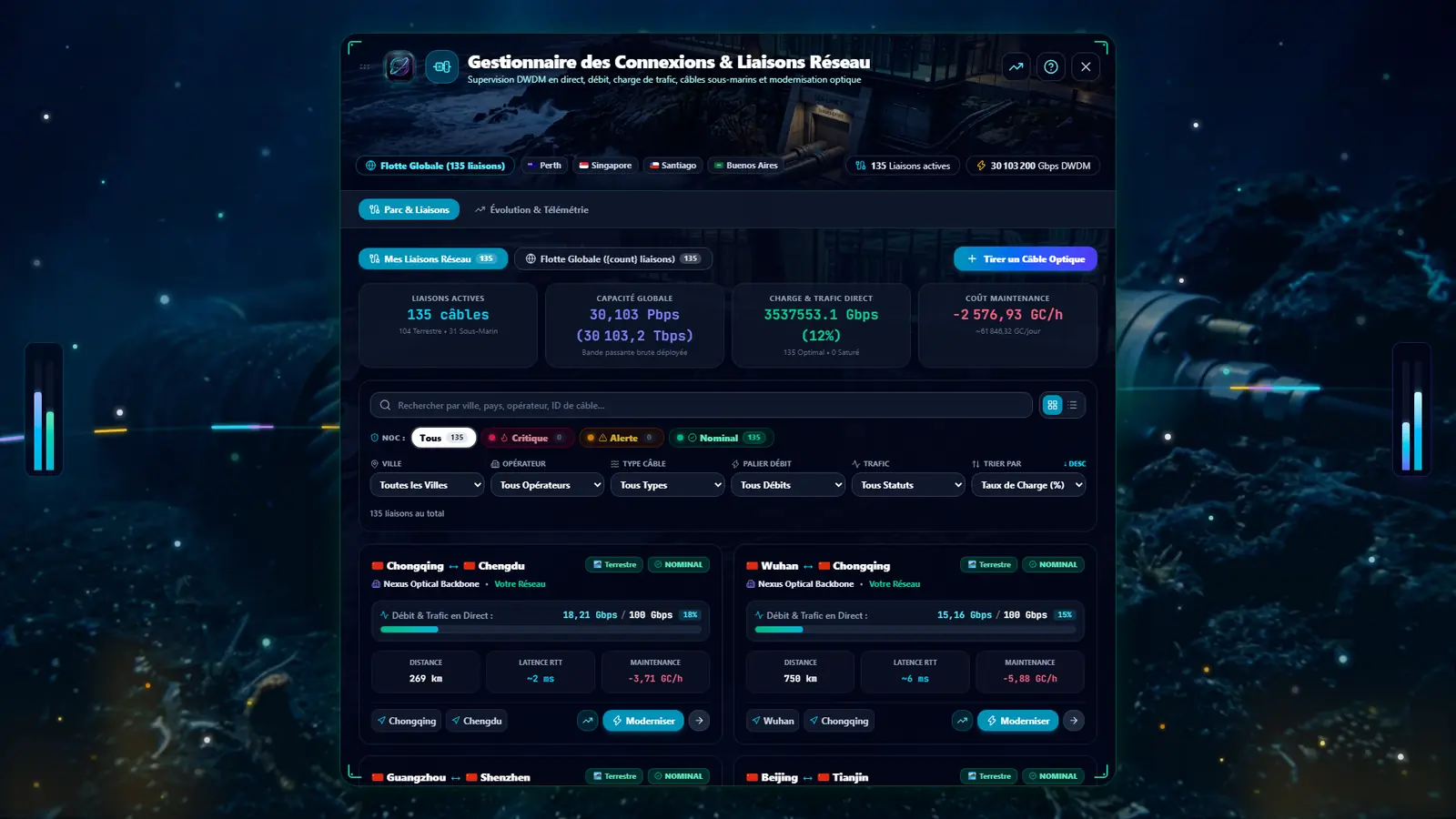
In Packet Dominance, an Internet service provider (ISP) builds its network on a map of 1,000 real cities: it installs points of presence (PoPs) in cities, then links them with terrestrial or subsea fiber cables. This network decides which residents subscribe, which services they reach and when a city saturates. Here are the engine's exact rules.
The PoP, a city's gateway
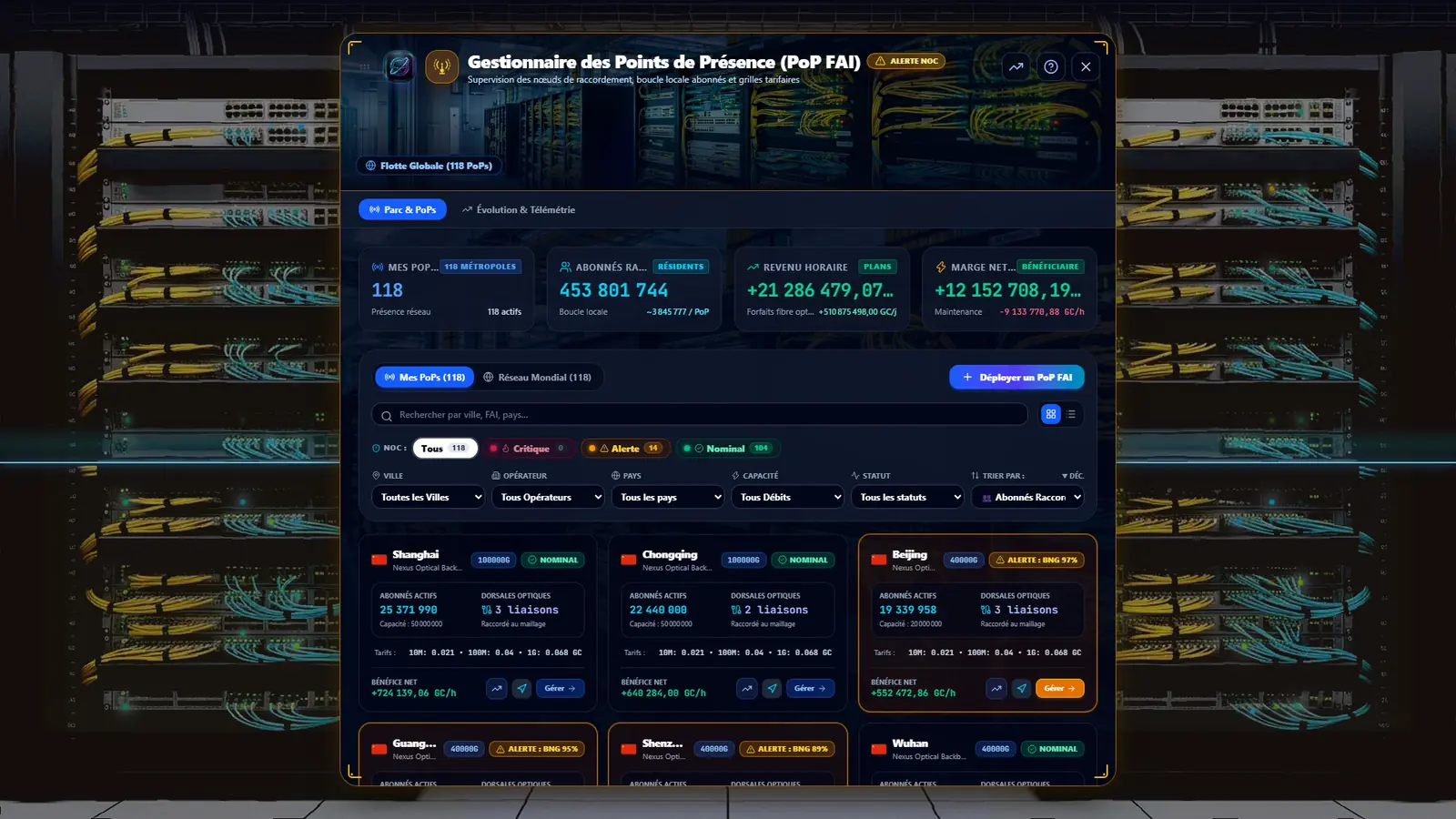
A PoP (point of presence) is the site where the operator connects a city's residents. Creating an ISP company costs 1,000 GC before tax and includes a first 100 Gbps PoP; each additional PoP costs 3,000 GC before tax, plus the country's taxes. A company has at most one PoP per city.
The heart of the PoP is its BNG chassis, the router that manages subscriber connections. It accepts 500 subscribers per Gbps: 50,000 for the starting 100 Gbps chassis, which costs 5 GC per hour in maintenance. It can be upgraded through 15 levels: 400 Gbps (200,000 subscribers), 1 Tbps (500,000), 4 Tbps (2 million)... The upgrade costs the difference in base price, 1,000 GC minimum.
Without a cable, a PoP's coverage caps at 5% of the population. Each Gbps of your company's cables arriving in the city adds 0.4 points, up to 85%, reached with 200 Gbps. Coverage then rises at each tick, that is, every real hour.
Laying a terrestrial or subsea cable
To link two cities, your ISP must have a PoP at each end; only one direct link is possible per pair of cities. The game alone decides whether the route is subsea, based on geography: crossing the Atlantic, the Pacific or the Mediterranean, a link to an island...
- Terrestrial cable: 10,000 GC + 12 GC per km × bandwidth multiplier + 3,500 GC per optical amplifier (one every 80 km) + the bandwidth hardware.
- Subsea cable: 50,000 GC + 35 GC per km × bandwidth multiplier + 15,000 GC per repeater (one every 60 km) + the hardware.
The multiplier is 1 at 10 Gbps, 1.8 at 100 Gbps (12,000 GC of hardware) and 3.2 at 1 Tbps (90,000 GC); bandwidths go up to 1,000,000 Tbps. Example: Paris–Lille at 10 Gbps costs 19,448 GC before tax. Maintenance then costs 0.35% of the price per hour (5 GC minimum). A subsea cable also goes through two coastal landing stations, out of 61 worldwide, at 15 to 22 GC per hour each.
Latency, RTT and route selection
RTT (round-trip time, the time a packet takes to travel there and back) follows a single rule: 0.010 ms per kilometer, plus 0.35 ms of equipment traversal per segment. Paris–Lille, about 204 km, shows 2.39 ms; a 6,000 km cable, 60.35 ms. A route's RTT is the sum of its segments; a subsea or damaged cable adds nothing extra.
The route is the shortest path in kilometers, regardless of who owns the cables. A congested cable (85% load) or a saturated one (95%) is heavily penalized, so that the route goes elsewhere if possible. Latency and route are informational: they change neither revenue nor subscribers.
Cable saturation and frozen cities
Each ISP subscriber sends 0.25 Mbps at peak hour, which means 4,000 subscribers per Gbps of cable. A city's traffic is spread across all the cables that reach it, whoever owns them, in proportion to their capacity. During an outage (solar storm, cut), a cable keeps 25% of its capacity.
A cable is saturated at 95% load. If all of a city's cables are saturated, the city is frozen: no PoP gains subscribers there, and neither services nor ad networks count its residents anymore. A city without a cable is never frozen. To unfreeze it, increase the bandwidth of one of its cables or lay another one.
Networks, transit and BGP
Cities linked by cables form a network, whoever the owners are. A service reaches the residents of every city in its network: hosted in Singapore, it will never reach Paris if no cable connects the two.
There is no toll on traffic: a cable's owner earns nothing for what passes through it. Each datacenter, however, pays an hourly transit fee to its partner ISP, from 2.00 GC per Gbps at Tiers 1 and 2 down to 0.30 GC at Tier 20, and services pay network transit of 0.15 GC per Gbps consumed by their subscribers.
In the BGP window, each company receives an autonomous system (AS) number, companies present in the same city appear as peers (eBGP peering), and the prefix table lists one /16 per PoP and one /24 per datacenter. Its Looking Glass traces the path between two cities, with the AS-path of the cable owners and the RTT. This window is informational: it has no effect on the game.
Getting started
- Choose a world from the home page: you start with 20,000 GC.
- Create your ISP in a populous city: the first PoP is included.
- Add a datacenter and a service on your network: without a hosted service, residents do not pay for their plans.
- Deploy a second PoP, then a cable to link the two cities and raise your coverage. Any questions? Drop by Discord.