
Packet Dominance datacenters: Tiers, 42U racks and energy
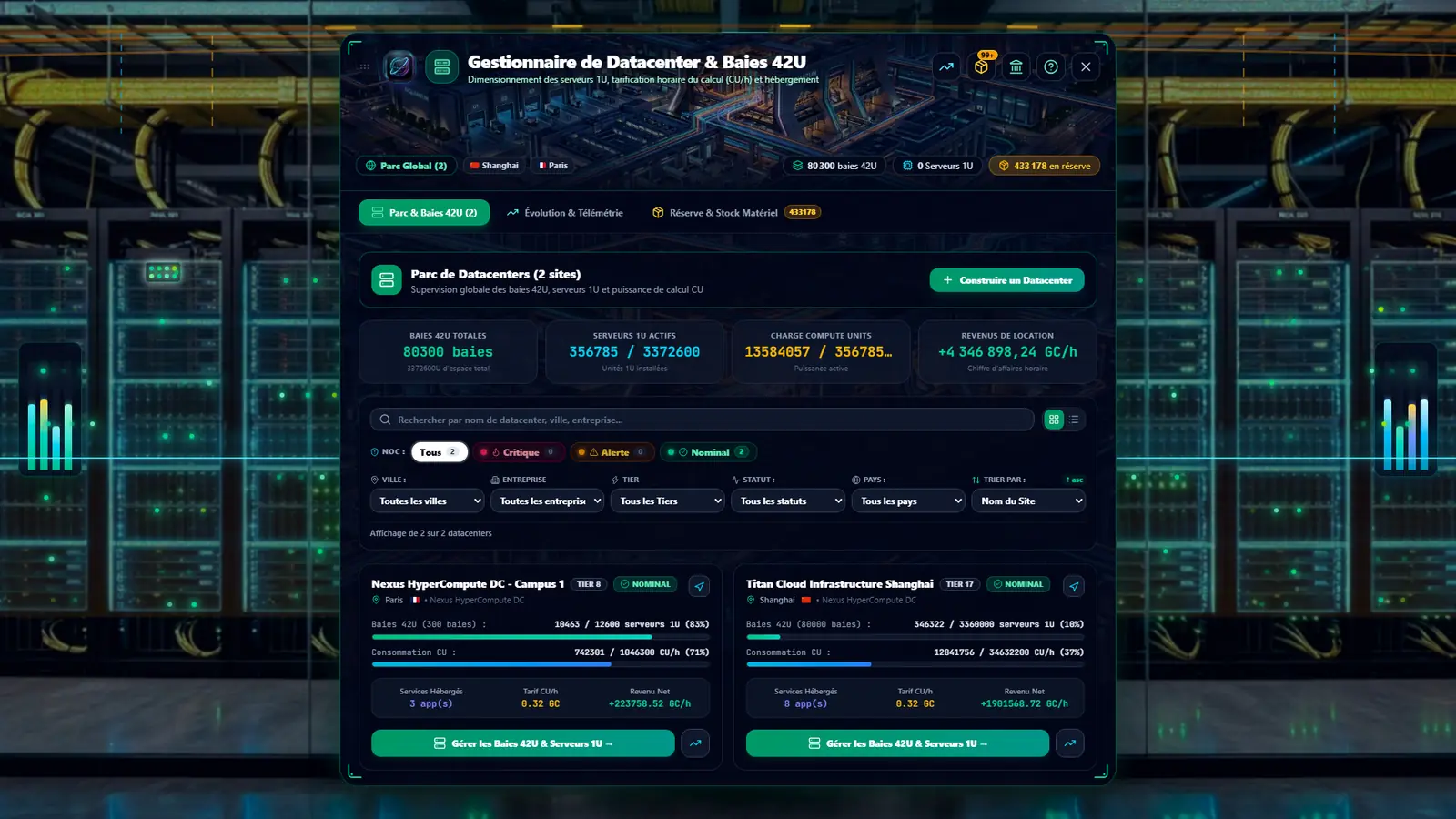
In Packet Dominance, a datacenter is a campus that rents computing power to players' digital services and ad networks. There are 20 levels, called Tiers, from the Micro Edge Pod at 5,000 GC up to Tier 20 at 2.2 billion GC. Power is measured in compute units (CU): a server provides 100 CU, and each tenant pays for the CU it consumes.
Building a campus
The city must have an ISP PoP, belonging to any player; that ISP becomes the campus's transit partner (see the fiber network).
- Price: the cost of the Tier, plus the country's datacenter tax and environmental contribution. A Tier 1 costs 5,000 GC before tax, or 6,225 GC including tax in France.
- When the company is created: you pay from your personal account and choose Tier 1, 2 or 3 (5,000, 15,000 or 32,000 GC before tax).
- Subsequent campuses: any of the 20 Tiers, paid from the company's account.
A datacenter never changes Tier: to get more racks, you build another campus.
The 20 Tiers, 42U racks and servers
Each Tier sets a number of 42U racks (a standard rack 42 units high). Each rack holds up to 42 1U servers, minus the space taken by security hardware. A few reference points:
- Tier 1, Micro Edge Pod: 1 rack, 5,000 GC.
- Tier 3, Modular Datacenter: 5 racks, 32,000 GC.
- Tier 5, Metropolitan Cloud Hub: 20 racks, 110,000 GC.
- Tier 9, AI Supercomputing Facility: 300 racks, 1,100,000 GC.
- Tier 20, Omnipresent Cosmic Matriochka: 640,000 racks, 2,200,000,000 GC.
Every new campus is delivered with a single server, that is 100 CU, whatever its Tier. Adding a server costs 150 GC before tax in hardware plus 15 GC for installation; hardware in reserve is used first, for the installation cost only. Removing servers is free: they go into the company's reserve, from which they can be reassigned or resold at 60% of the new price.
Security hardware also takes up slots: 1U firewall (3,500 GC), 2U filtering appliance (14,000 GC) and 4U chassis (40,000 GC). Its role against DDoS attacks is described in crises and cyberwarfare.
What about GPUs? The game does not model them: all power is expressed in CU, artificial intelligence services included. A name like "AI Supercomputing Facility" grants no special capacity.
Energy and PUE
Every hour, a datacenter pays for its electricity before tax: racks × 25 + servers × 0.60 + firewalls × 15 + filtering appliances × 50 + chassis × 140 GC. A Tier 1 with its starting server therefore consumes 25.60 GC per hour.
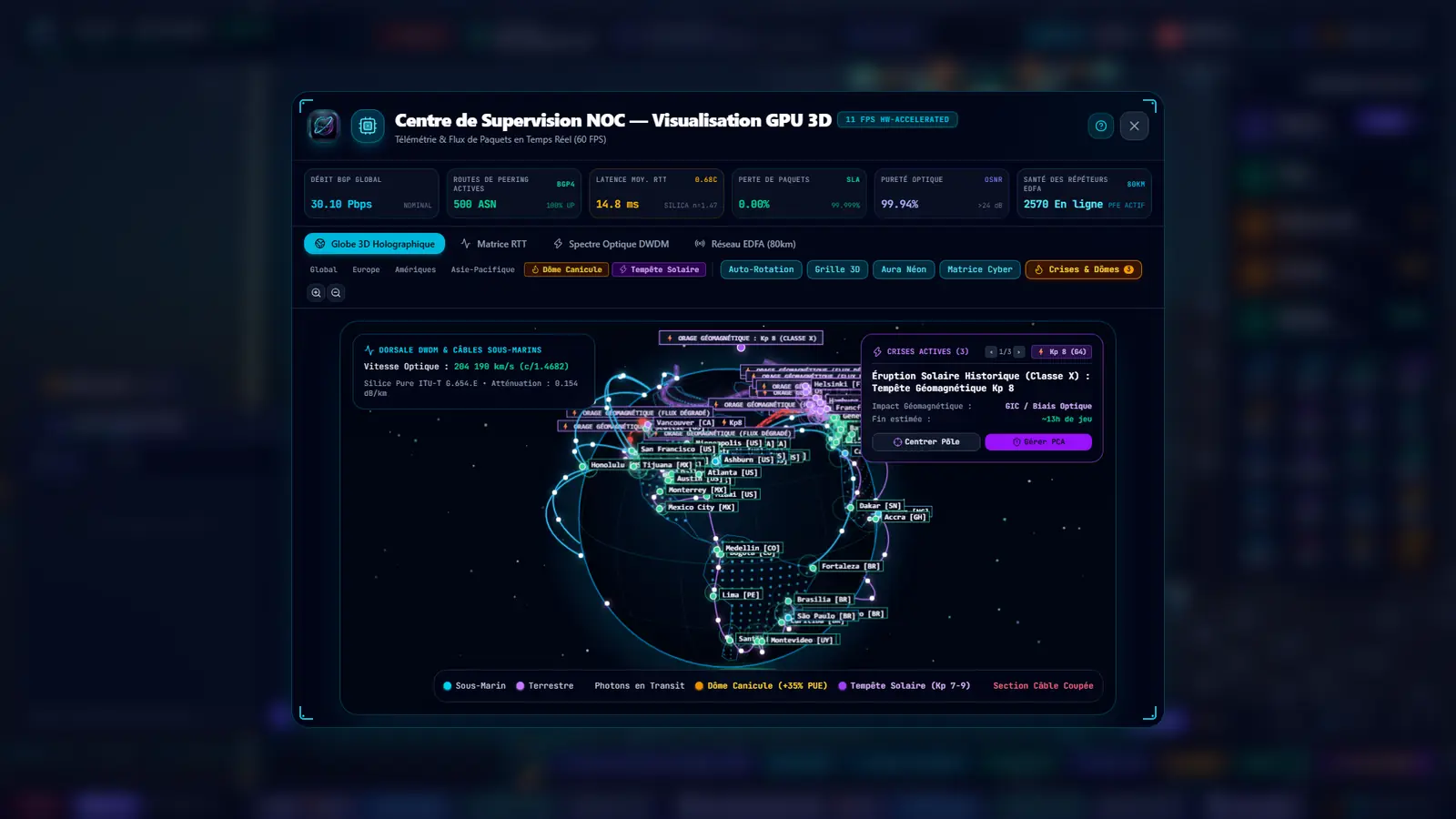
PUE (Power Usage Effectiveness, the ratio between the site's total energy and the energy used by the servers alone) is 1.25 in every datacenter, whatever the Tier. It is used to calculate the environmental contribution on the energy bill. During a heatwave or a solar storm, the PUE applied is increased by 35% or 50%, and an electricity surcharge is added (see crises and cyberwarfare).
Renting compute in CU
A datacenter's revenue comes from the CU it rents out:
- to services: subscribers × CU per subscriber (from 0.005 to 0.08 depending on the service) × CU price;
- to ad networks: 1 CU per 500 people of audience, 10 minimum, × CU price.
The default price is 0.16 GC per CU per hour, adjustable from 0.001 to 10 GC. It applies to all of the campus's tenants; the engine varies neither their number nor their choice according to this price.
Example, excluding salaries and taxes: a Tier 1 brought up to 20 servers offers 2,000 CU. If it rents out 1,500, it collects 240 GC per hour, against 37 GC of energy and 20 GC of transit.
Watch the load: between 100% and 130% of CU in use, the growth of hosted services drops to 30% of normal; above 130%, or with no server, they lose 15% of their subscribers at each tick. The Nagios monitoring console flags a datacenter from 80% load.
Transit, staff and dismantling
- Transit: every hour, the datacenter pays its partner ISP the bandwidth of its Tier multiplied by its rate, from 2.00 GC per Gbps at Tiers 1 and 2 down to 0.30 GC at Tier 20, that is 20 GC per hour for a Tier 1. If that ISP is dissolved or no longer has a PoP in the city, transit stops, with no replacement.
- Staff: 3 employees at Tier 1, 5 at Tier 2, 9 at Tier 3, up to 2,500 at Tier 20, plus one per block of 10,000,000 CU consumed by tenants. Salaries are paid into the city fund.
- Dismantling: only possible once the campus no longer hosts any service or ad network. The Central Bank pays 30% of the cost of the Tier, and all the hardware goes into reserve.
Getting started
- Choose a world from the home page: you start with 20,000 GC.
- Find a city that has an ISP PoP, yours or another player's.
- Build a Tier 1, then make a transfer to the company's account, which opens at 0 GC.
- Add servers as your tenants grow and launch a digital service.