
Packet Dominance economy: central bank, taxes and the Exchange
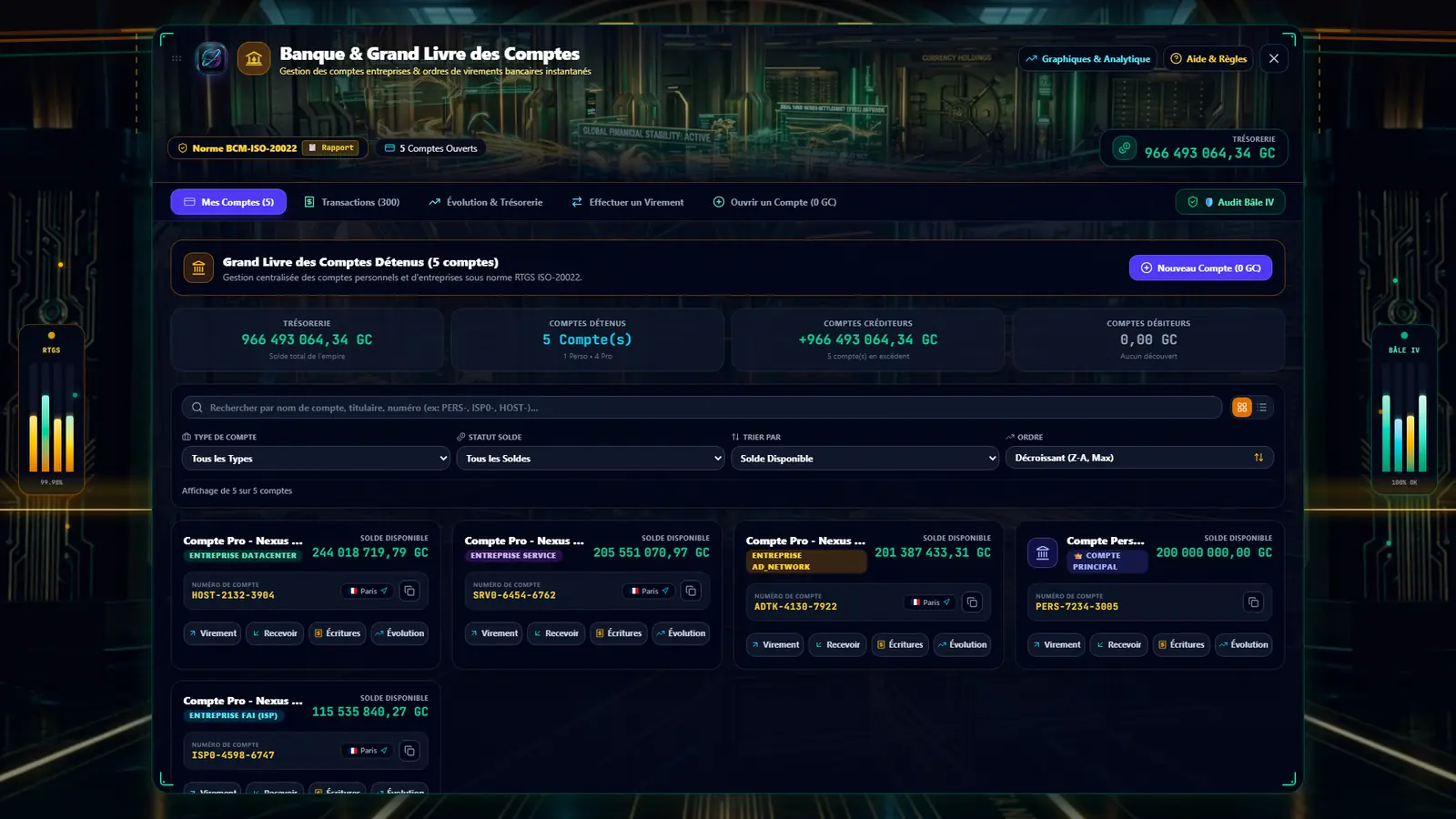
In Packet Dominance, the whole economy rests on a single currency, the GC, issued once and for all by a Central Bank. Every real hour, a tick settles your companies' revenue and costs, levies the taxes of each asset's country and updates your accounts.
The Central Bank, sole source of money
The World Central Bank (account BCM0-0000-0000) receives 999,999,999,999 GC when the world is created: this is the only money creation in the game. It pays each new player their starting capital of 20,000 GC, collects the pre-tax portion of your purchases and pays out salvage values when you dismantle. Taxes never go to it: they go to the Treasury of the country concerned.
At the end of each tick, the server checks that the sum of all accounts remains equal to this initial endowment. No GC is created or destroyed during the game. A tick takes place every 3,600 seconds: one hour of play lasts one real hour, whether you are logged in or not.
Personal account, companies and headquarters
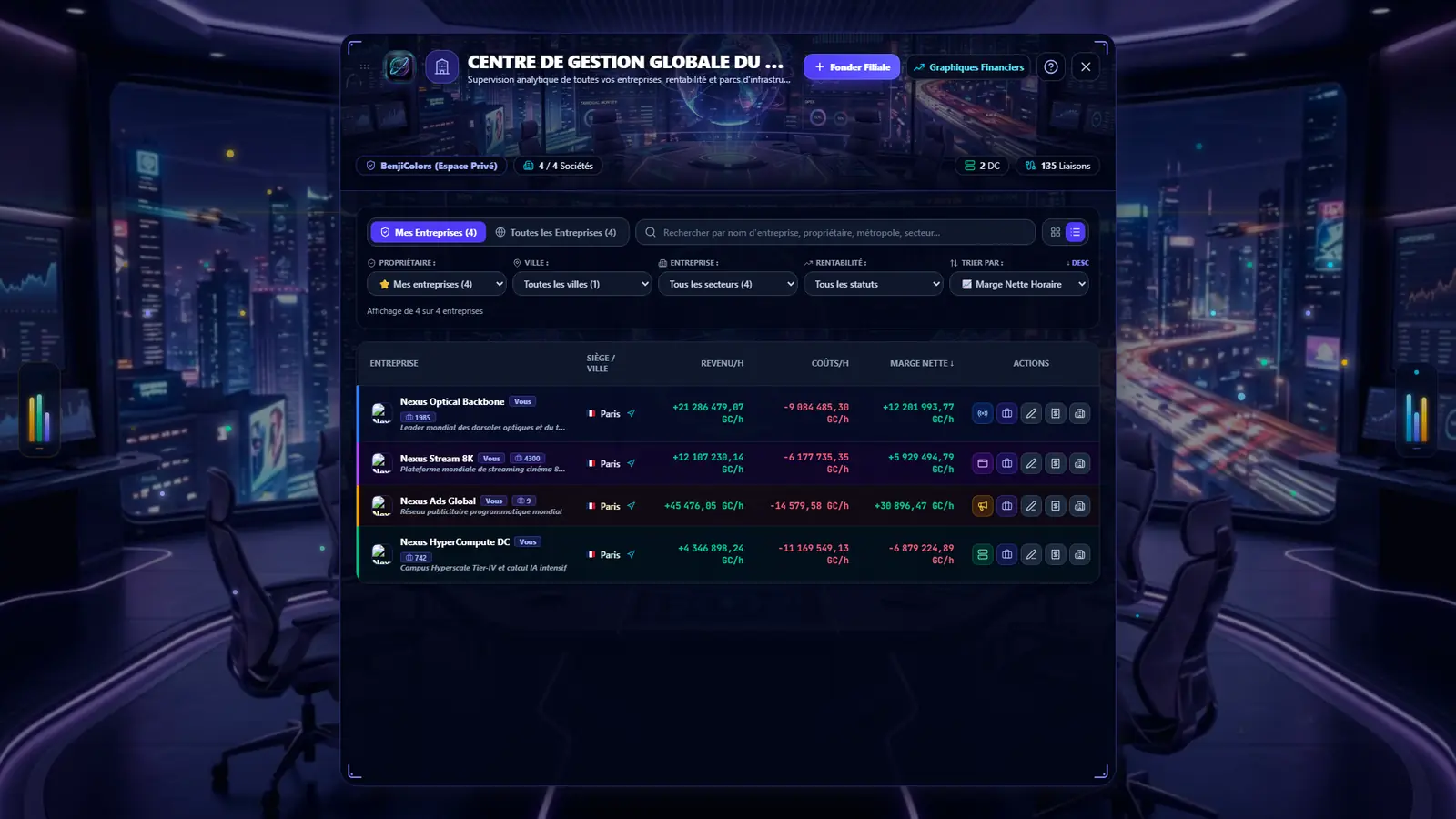
Your personal money sits in a PERS- account. It pays for creating your companies and for your operations on the Exchange. Each company has a single line of business and owns a single operating account, opened at 0 GC: this is the account the tick credits and debits. You fund it by transfer, free of charge and tax-free.
- ISP (account
ISP0-): 1,000 GC before tax, or 1,230 GC including tax in France, first PoP included. - Hosting provider (account
HOST-): 5,000 GC before tax for Tier 1, or 6,225 GC including tax in France. - Service publisher (account
SRV0-): 2,500 GC before tax, or 2,975 GC including tax in France. - Ad network (account
ADTK-): 3,500 GC before tax, or 4,165 GC including tax in France.
Personal sub-accounts also open at 0 GC, for your transfers only. The headquarters is the city where the company is founded and never changes, even after a sale. Taxes, however, follow the country of each asset; the headquarters country only matters for the sale of the whole company.
No loans: overdraft, seizure and judicial sale
The Central Bank lends nothing and there is no borrowing at all. A purchase or a transfer requires the necessary balance; otherwise, the "Express Transfer" button offers to transfer the shortfall from one of your accounts that covers all of it. However, tick costs (energy, transit, salaries, hosting, taxes) are deducted even if the balance goes negative: the company is then overdrawn.
- Each tick that ends below 0 GC advances the deficit counter; it drops back to zero as soon as a tick ends at 0 GC or more.
- The Central Bank sends you an alert email every 24 ticks.
- On the 240th consecutive tick, that is 10 days, the company is seized and put up for judicial sale for 10 days: starting price of 35% of the value of its assets (500 GC minimum), buy-now price of 3.5 times the starting price, bid increment of 250 GC.
- With no buyer, it is dissolved: accounts frozen, infrastructure destroyed with no value.
The buyer inherits the negative balance, with no debt write-off, but the company's counter starts again from zero.
A tax system for each of the 242 countries
Each of the game's 242 countries has its own tax authority, rate schedule and public Treasury (TRES-FR-0001 for France). Five sector taxes, called VAT 1, cover connections, PoPs, datacenters, services and sales on the Exchange. On top of that comes an environmental contribution, VAT 2, on almost every flow. In France, a PoP is taxed at 12.5% plus a 10.5% environmental contribution: that is why an ISP at 1,000 GC before tax costs 1,230 GC including tax.
A cable between two countries splits its taxes: VAT 1 is calculated at the average rate and split 50/50 between the two Treasuries, and VAT 2 at each country's rate on its half. Transfers, salaries, the BCP and cyberwarfare fines are not taxed.
The Exchange: only whole subsidiaries are sold
You never sell an isolated datacenter, cable or service there, but a whole subsidiary: its accounts with their exact balance, positive or negative, and all its infrastructure.
- Fixed price: the buyer pays and receives the company immediately.
- Auction: 5, 15, 30 or 60 minutes, 6 hours or 24 hours, 60 minutes by default. Each bid is placed in escrow and returned as soon as a rival outbids it. The increment is 5% of the starting price (25 GC minimum). A bid placed in the last minute pushes the end back to 60 seconds after it.
- Transfer duty: from 2% to 6% depending on the company's country, paid by the buyer; the seller receives 100% of the price.
Price, escrow and duties go through the personal account.
What does not exist, and where to start
- No dividends: revenue stays in the company's account; to move it, make a transfer.
- No loans and no interest rates.
- No voluntary dissolution: to part with a company, sell it.
With 20,000 GC, an ISP, a Tier 1 datacenter and a first service fit within the starting budget. Choose a world to begin, then discover services and their subscribers and crises and cyberwarfare. Your questions are welcome on the Packet Dominance Discord.