
Packet Dominance: the grand strategy of the Web's foundations
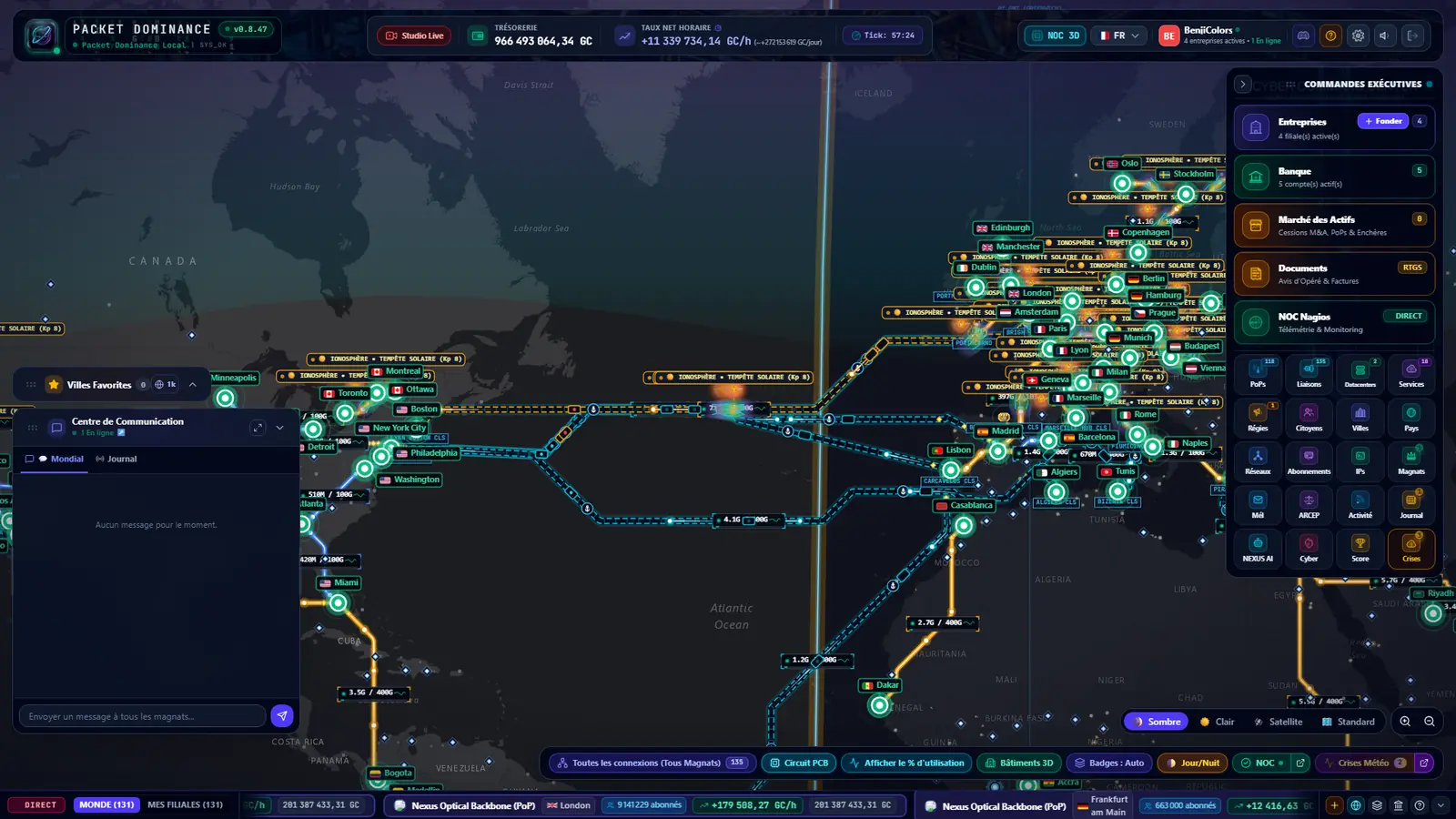
Every day, we send messages, watch videos, pay online and query AI models without thinking about what makes it all possible: cables laid on the ocean floor, points of presence in every city, server rooms that consume electricity every hour. This machinery is almost invisible. I wanted to turn it into a playground.
By Benjamin Vincent (BenjiColors), creator of Packet Dominance.
Packet Dominance is a free multiplayer economic strategy game, played in the browser. You build a group that owns the Internet's infrastructure: fiber networks, datacenters, digital services and ad networks. The world is persistent: one hour of play lasts one real hour, and the economy keeps running when you are not logged in. Here is how it works, with the engine's real figures.
A map of 1,000 real cities
The game takes place on a world map with 1,000 real cities, drawn from the GeoNames geographic database: real coordinates, real populations, nearly 1.5 billion inhabitants in total. Each city has its own pace: an operator's coverage grows there by 0.5 to 1.9% per hour depending on the city, up to its cap.
The game's 242 countries each have their own tax system and public Treasury. One simple rule applies everywhere: a purchase or a flow is taxed in the country where the asset is located, not in the country of the headquarters.
Each new player receives 20,000 GC (the game's currency) in their personal account. That's all. There is no free passive income and no login bonus: what you earn afterwards comes from what you build.
Four lines of business, one value chain
A company has a single line of business, but you can found as many as you like. There are four:
- Internet service provider (ISP): it deploys points of presence (PoPs) and fiber cables, and sells plans to residents.
- Hosting provider: it builds datacenters and rents out their computing power.
- Service publisher: it runs applications (streaming, gaming, AI, online banking…) hosted in a datacenter.
- Ad network: it promotes a service and brings it subscribers.
These businesses depend on one another. Residents pay their plans to the ISP and their subscriptions to the services. The datacenter pays its IP transit to the ISP in its city. Services and ad networks rent compute units from the datacenter. The service pays for its campaigns to the ad network, which brings it new subscribers. Each flow is an entry in the General Ledger, which opens as an invoice.
The network: PoPs, fiber and saturation
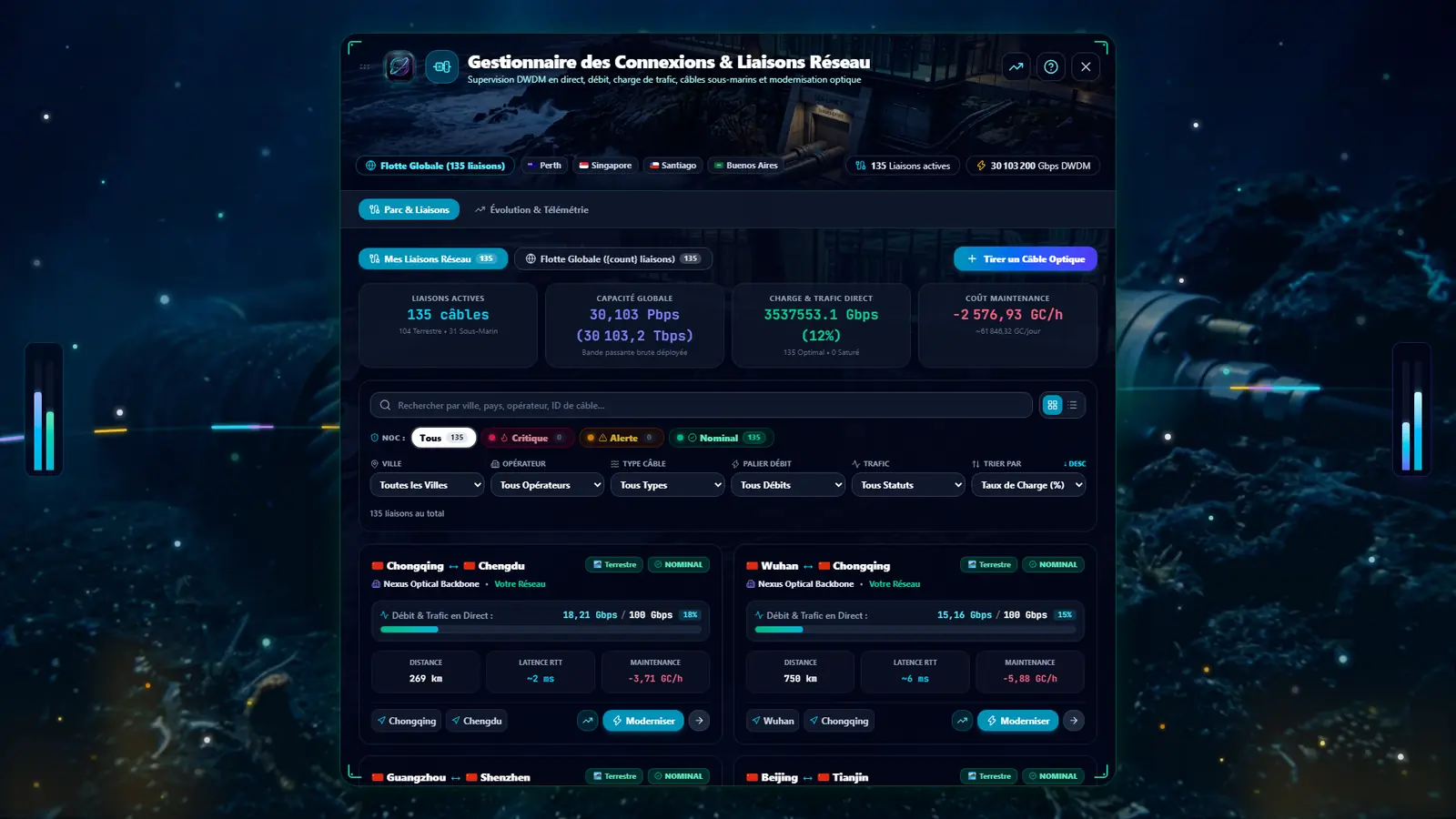
Everything starts with the network (network details). Founding an ISP costs 1,000 GC before tax and includes a first 100 Gbps PoP; each additional PoP costs 3,000 GC before tax, with only one PoP per company per city. A PoP's chassis can be upgraded across 15 levels, and each accepts 500 subscribers per Gbps, that is 50,000 subscribers for the first one.
To link two cities, you have to lay a cable. The engine calculates the real distance and decides by itself whether the link is terrestrial or subsea:
- Terrestrial: 10,000 GC, plus 12 GC per kilometer multiplied by the bandwidth coefficient, plus 3,500 GC per amplifier (one every 80 km).
- Subsea: 50,000 GC, plus 35 GC per kilometer multiplied by that coefficient, plus 15,000 GC per repeater (one every 60 km).
Thirteen bandwidth levels range from 100 Mbps to 1,000,000 Tbps. A cable then costs 0.35% of its price every hour, with a minimum of 5 GC.
Bandwidth is not decorative. Each subscriber in a city consumes 0.25 Mbps on the cables that leave it, that is 4,000 subscribers per Gbps. A cable is saturated at 95% of its capacity. When all of a city's cables are saturated, the city is frozen: no PoP gains subscribers there until you increase the bandwidth or lay another cable.
The access market
An ISP sells four plans: 10 Mbps, 100 Mbps, 1 Gbps and 10 Gbps, at 0.021, 0.040, 0.068 and 0.167 GC per hour by default. Prices are free to set, and a new price applies to all subscribers from the next tick: no old rate is kept.
The ISPs of a city share a single market, which never exceeds its population. New subscribers go to the cheapest in each tier, and at each tick, 10% of a more expensive ISP's subscribers leave for the cheapest one. A price war is therefore played out city by city, tier by tier.
One rule often comes as a surprise: plans bring in nothing as long as no digital service, belonging to any player, is hosted in a city of the network. Internet access with nothing to look at does not sell. On the other hand, local loop maintenance (0.020 GC per subscriber per hour) is due in every case.
Datacenters: racks, servers and compute units
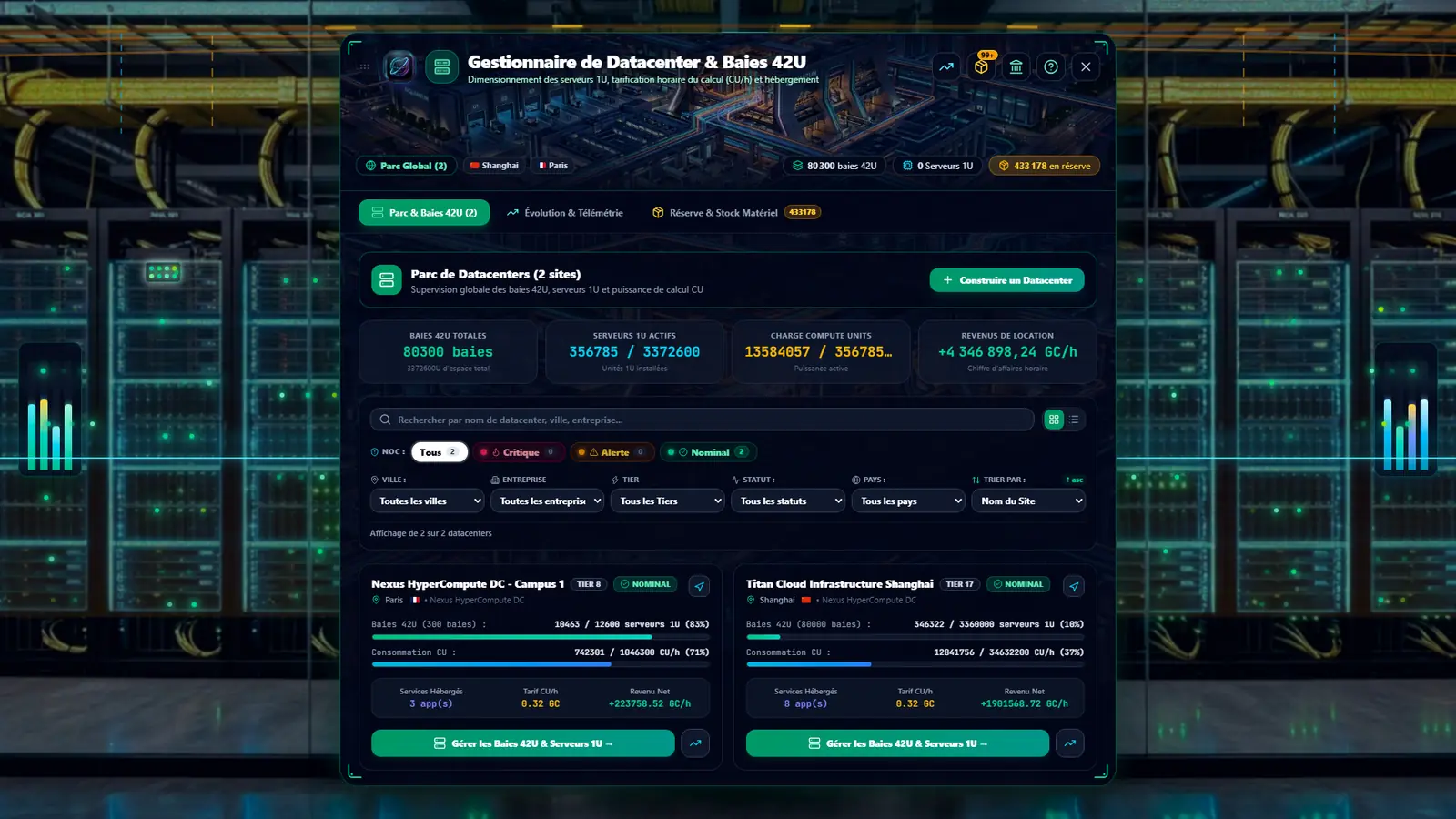
To build a datacenter (datacenter details), you need a PoP in the city, belonging to any player; that ISP becomes its transit partner. There are 20 levels, from Tier 1 (1 rack, 5,000 GC) to Tier 20 (640,000 racks, 2,200,000,000 GC). A datacenter never changes level: to grow, you build another campus.
The 42U racks come pre-installed. The datacenter is delivered with one server; each 1U server provides 100 compute units (CU) and costs 150 GC before tax, plus 15 GC for installation. You can remove servers, but never below what the hosted services and ad networks consume.
The hosting provider freely sets the price of its CU, 0.16 GC per CU per hour by default. It pays for energy (25 GC per hour per rack, 0.60 GC per server, with a PUE of 1.25 in every datacenter) and for transit to its ISP, from 2.00 GC per Gbps per hour at the first levels down to 0.30 GC at Tier 20.
Services: 100 competing applications
Founding a service publisher costs 2,500 GC before tax (service details). The catalog has 100 services spread across 10 categories: streaming, gaming, artificial intelligence, storage, social networks, business software, fintech, cybersecurity, e-commerce and connected health. Each has its own bandwidth per subscriber, compute consumption and recommended price.
A service starts with 100 subscribers and aims for a target calculated at each tick: the connected population of its network, the interest share of its category, the bandwidth required, the network bonus (+15% per city beyond the first, up to +250%) and the ratio between the best price in the world and yours.
Competition is real. Every five ticks, a service with more than 50 subscribers that is not the cheapest in the world for its type loses 10% of its subscribers. They do not go to the competitor: they are lost.
The in-game guide gives an example I am fond of: the 8K cinema platform, with 1,000 subscribers at 19.99 GC per month and CU at 0.16 GC, brings in 27.76 GC per hour. After compute, transit and salaries, it has 0.26 GC left before taxes. At that price, it loses money below 1,000 subscribers. Margins are earned through volume and price tuning.
If the datacenter's city no longer has a PoP or a cable, the service stops earning and paying anything. On the sixth consecutive tick, its subscribers drop to zero, but the service is never deleted: it restarts from 100 subscribers when reconnected. It can also be moved to another datacenter on the same network, for 200 GC plus 2 GC per CU before tax, keeping its subscribers.
Ad networks
An ad network costs 3,500 GC before tax and promotes one of your services, in the same city or on the same network. A slider sets its reach, from 5% to 100% of interested residents who are not yet subscribers. It rents 1 CU per 500 people of audience (at least 10), and the service pays it 0.002 GC per person per hour.
In return, the partner service gains 3% of that audience as new subscribers at each tick. Since the ad network and the service both belong to you, the campaign money moves from one of your companies to another: what your group really gains is those subscribers.
Banking, taxes and the Exchange
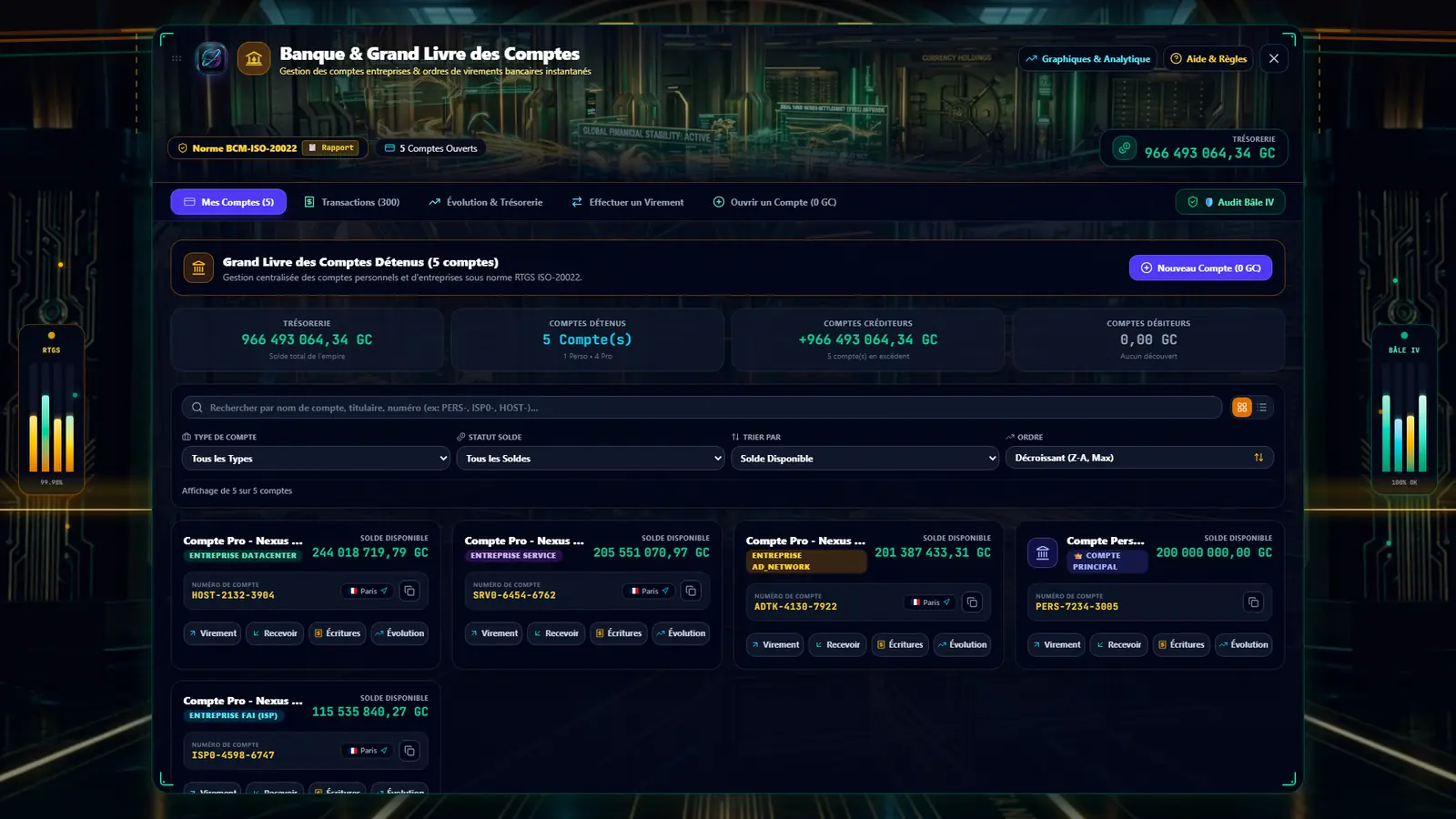
The economy is kept in proper accounts, to the cent (economy and banking). Each company has its own account, and transfers between accounts are instant. The World Central Bank (BCM) is the only source of money: the sum of all accounts remains equal to its original reserve, and a check verifies this at each tick. It lends nothing, and no dividend is paid to the personal account.
Purchases and most hourly flows carry two taxes, a sector tax and an environmental tax, at the rate of the asset's country. Each invoice shows the taxes actually levied and the Treasury that collected them.
On the Exchange, only whole subsidiaries are sold, with all their PoPs, cables, datacenters, services and ad networks: a single asset is never sold. The sale takes place at a fixed price or by auction, from 5 minutes to 24 hours, and bids are held in escrow.
An overdrawn subsidiary has a counter: it advances at each negative tick and drops back to zero as soon as a tick ends at break-even. After 240 consecutive negative ticks, that is 10 days, the Central Bank seizes it and puts it up for judicial sale for 10 days, with a starting price of 35% of the value of its assets.
Crises and cyberwarfare
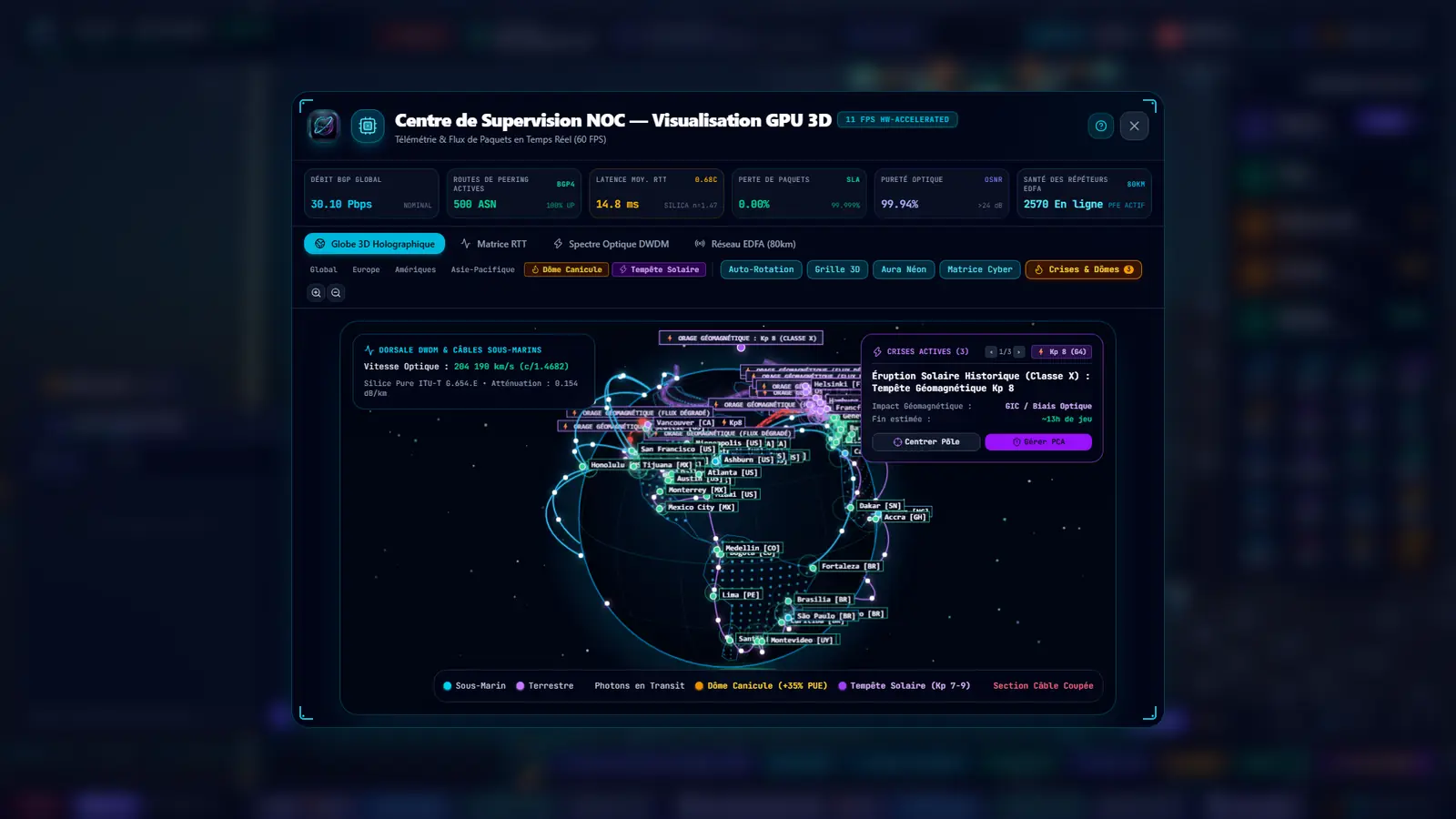
The world is not stable (crises and cyberwarfare). Heatwaves and solar storms weigh down the datacenters' energy bill; storms and cable cuts reduce a link's capacity to 25%. A business continuity plan, at 2,500 GC, reduces crisis surcharges.
Players can also attack each other. A denial-of-service attack mobilizes the CU of one of your datacenters against a rival's service: 500 GC to launch plus the price of anonymity, then 0.20 GC per CU per hour. Defense is hardware-based (1U firewall, 2U filtering appliance, 4U chassis). At each tick, the game's ARCEP tries to unmask the attacker, and the owner of the targeted service can file a complaint free of charge before its tribunal.
AI agents in the game
Packet Dominance exposes an MCP (Model Context Protocol) server (AI agents and MCP). A player can plug in their AI assistant, for example Claude Code or Cursor, with their own API key, without installing the game's source code: the configuration is ready to copy from the settings. The agent acts with your key, under the same rules as you and with a limited request rate. It can read your accounts, adjust your plan prices or deploy a PoP; it cannot do anything you could not do yourself.
An independent project
Packet Dominance is an independent project that I develop for the Discord community "Le Repère du GeeK Forcené" (about). The game runs in the browser, built with React, with a Node.js server and an SQLite database, and it is translated into 8 languages, including Arabic, with a right-to-left layout.
The guide built into the game is checked against the code by automated tests: when an engine rule changes, the test fails until the guide is corrected. The figures in this article have been checked against the engine's code.
Joining the game
If you enjoy management games that make you calculate, if you work in networking or the cloud and want to see your job from another angle, or if you want to have an AI agent play in a persistent world, there is a place for you. Some worlds are invitation-only: the code can be requested on our Discord server.
I did not try to make the most spectacular game, but a game where every gigabit and every cent has an origin. The rules are described in detail here. The rest you discover by laying your first cable.